Google’s Latest Search Changes: What Businesses Need to Know About SEO and AI Visibility
Google Search is changing faster than ever.
For years, businesses mainly focused on ranking higher in traditional Google search results. The goal was simple: optimize pages, target keywords, build authority, and get more organic traffic.
But now, Google Search is becoming more AI-powered.
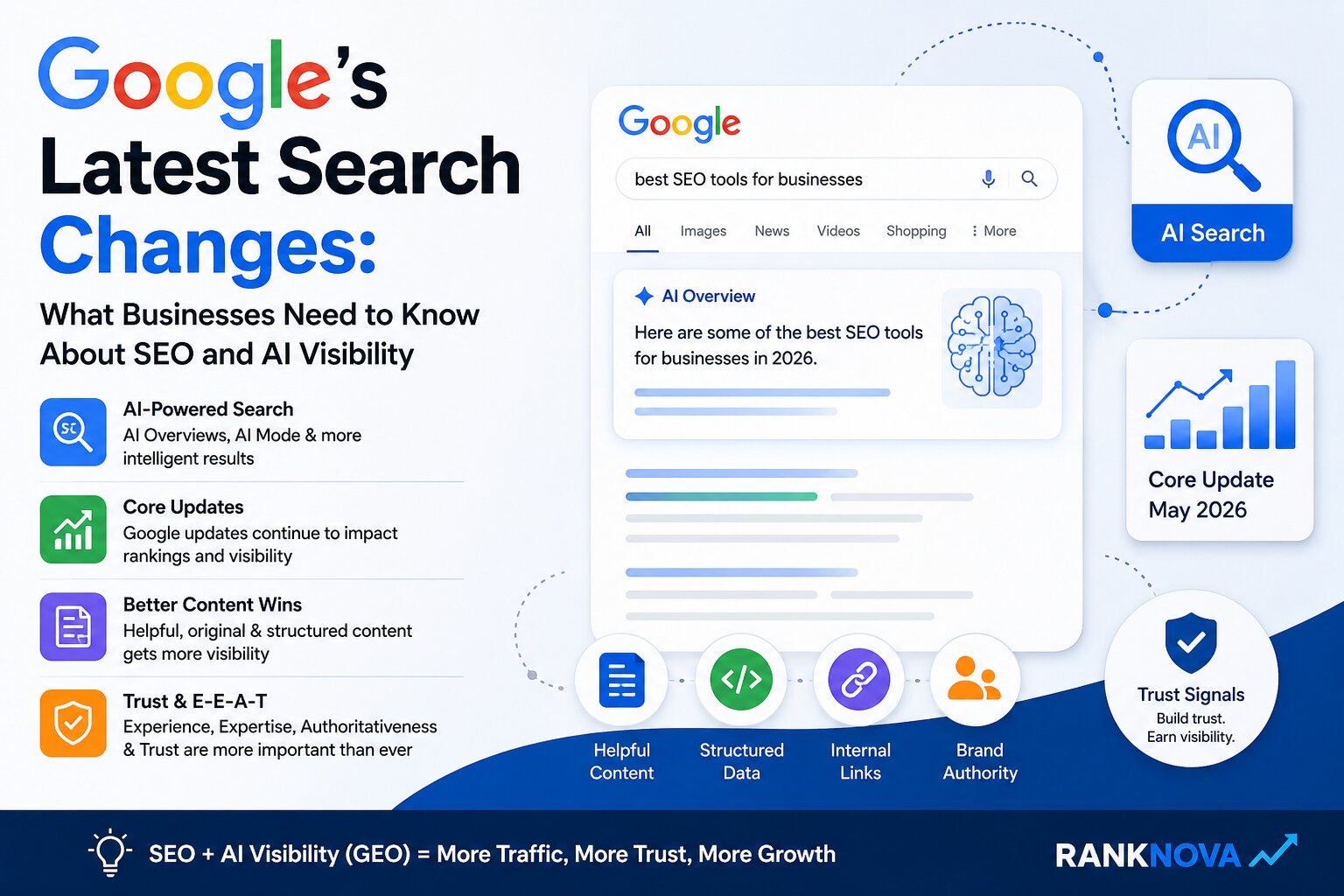
With AI Overviews, AI Mode, more conversational search experiences, and regular core updates, businesses need to think beyond normal SEO. It is no longer only about ranking in blue links. It is also about whether Google and AI systems can understand, trust, and mention your brand in AI-generated answers.
This is where SEO and AI visibility now work together.
What Changed in Google Search?
Google is moving Search toward a more AI-powered experience.
Instead of only showing a list of links, Google is increasingly giving users direct answers, summaries, recommendations, and AI-generated explanations.
This means users may not always click multiple websites to find answers. In many cases, they may get the answer directly from Google’s AI-powered search results.
For businesses, this creates a new challenge.
Your website should not only rank well. Your content should also be clear, trusted, structured, and useful enough to be selected or referenced by AI-powered search experiences.
Why Google Core Updates Still Matter
Google core updates are broad changes to Google’s ranking systems.
These updates can affect how websites perform in search results. Some websites may see traffic improvement, while others may see ranking drops.
A core update does not usually target one specific website. Instead, it improves how Google evaluates content quality, usefulness, relevance, and trust.
If your website traffic changes after a core update, it may be a sign that your content, authority, or user experience needs improvement.
What This Means for Business Websites
The latest direction of Google Search shows one clear trend:
Businesses need to optimize for both traditional search and AI-powered discovery.
Earlier, a website could focus mainly on keywords, backlinks, and technical SEO.
Now, businesses also need to focus on:
- Clear brand information
- Helpful and original content
- Strong topical authority
- Structured data
- FAQ-based content
- Trust signals
- Expert insights
- Consistent business details
- User-focused pages
- AI-readable content structure
Google’s AI-powered search experience needs content that is easy to understand, verify, and summarize.
SEO Is Still Important, But It Is Not Enough
SEO is not dead.
In fact, SEO is still the foundation of online visibility. Your website still needs proper indexing, strong page structure, fast loading speed, mobile optimization, internal links, and useful content.
But SEO alone is no longer enough.
A business may rank on Google but still not appear in AI-generated answers.
That is why businesses need GEO, also known as Generative Engine Optimization.
GEO helps your brand become more visible inside AI-powered platforms and answer engines.
What Is GEO?
GEO stands for Generative Engine Optimization.
It is the process of improving your website, content, and brand signals so AI systems can understand and recommend your business.
GEO focuses on how your brand appears in AI-generated answers from platforms like:
- Google AI Overviews
- Google AI Mode
- ChatGPT
- Gemini
- Perplexity
- Claude
- Bing Copilot
While SEO focuses on rankings, GEO focuses on AI mentions, citations, recommendations, and brand visibility inside AI answers.
How Google AI Search Changes User Behavior
Traditional search behavior looked like this:
User searches a keyword → Google shows results → User clicks a website → User reads the answer.
AI-powered search behavior is different:
User asks a detailed question → AI summarizes the answer → User may only click if they need more detail.
This means businesses need to create content that can be used in answer-style search experiences.
Your content should directly answer customer questions, explain topics clearly, and show why your brand is trustworthy.
What Type of Content Works Better Now?
In the new search environment, generic content is becoming weaker.
Businesses should avoid publishing thin, copied, or keyword-stuffed content.
Instead, they should create content that is:
- Helpful
- Original
- Easy to read
- Based on real expertise
- Structured with clear headings
- Supported by examples
- Updated regularly
- Focused on user intent
- Connected with related internal pages
Google and AI systems both need clear context.
If your content is vague, outdated, or too generic, it may not perform well in search or AI answers.
Important SEO Actions After Google’s Latest Changes
Here are the most important actions businesses should take now.
1. Review Your Existing Content
Check your old pages and blogs.
Ask these questions:
- Is the content still accurate?
- Does it answer the user’s question clearly?
- Is it better than competing pages?
- Does it show expertise?
- Does it include examples or useful insights?
- Is it updated for current search behavior?
Old content should not be ignored. Updating existing pages can improve both SEO and AI visibility.
2. Improve Page Structure
Good structure helps both users and search engines.
Every important page should have:
- One clear H1 heading
- Proper H2 and H3 headings
- Short paragraphs
- Bullet points where useful
- Internal links
- FAQ section
- Clear call to action
Structured content is easier for AI systems to understand and summarize.
3. Add FAQ Sections
FAQ sections are useful because they match how users ask questions in AI search.
For example, instead of only targeting “SEO audit tool,” create answers for questions like:
- How do I check my website SEO?
- Why is my website not ranking on Google?
- How do I improve AI visibility?
- What is the difference between SEO and GEO?
Question-based content can help your website become more useful for AI-powered results.
4. Use Structured Data
Structured data helps search engines understand your website better.
Important schema types include:
- Organization schema
- Article schema
- FAQ schema
- Breadcrumb schema
- Product schema
- Service schema
- LocalBusiness schema
Schema does not guarantee rankings, but it helps search engines understand your content more clearly.
5. Build Brand Trust Signals
AI-powered search depends heavily on trust and clarity.
Your website should include:
- About page
- Contact page
- Case studies
- Customer reviews
- Testimonials
- Author information
- Social profiles
- Clear service pages
- Consistent brand details
If your brand information is weak or inconsistent, AI systems may not confidently understand or recommend your business.
6. Create Topic Clusters
One blog post is not enough to build authority.
Businesses should create topic clusters around important subjects.
For example, if your business offers SEO services, you can create a cluster around:
- What is SEO?
- Technical SEO checklist
- SEO audit guide
- Common SEO mistakes
- SEO vs GEO
- How AI search affects SEO
- How to improve Google rankings
This helps Google and AI systems understand your expertise in a complete topic area.
7. Track Rankings and AI Visibility Together
Businesses should not only track keyword rankings now.
They should also track whether their brand appears in AI answers.
Important visibility metrics include:
- Google keyword rankings
- Organic traffic
- Impressions
- Click-through rate
- AI mentions
- AI citations
- GEO score
- Brand visibility in AI tools
This gives a better picture of your real search performance.
Common Mistakes Businesses Should Avoid
After Google’s latest search changes, businesses should avoid these mistakes:
- Writing content only for keywords
- Ignoring AI search visibility
- Publishing thin AI-generated content without value
- Not updating old blogs
- Missing schema markup
- Weak internal linking
- No clear brand positioning
- No FAQ sections
- Poor page speed
- Inconsistent business information
The biggest mistake is thinking that old SEO methods alone will be enough.
Search is changing, and businesses need to change with it.
How RankNova Helps Businesses Adapt
RankNova helps businesses improve visibility across traditional search and AI-powered search.
With RankNova, businesses can analyze their website, find SEO issues, improve content, and understand how ready they are for AI search.
RankNova helps with:
- Website SEO audit
- Technical SEO checks
- Meta title and description analysis
- Content structure suggestions
- Internal linking recommendations
- Structured data checks
- AI visibility analysis
- GEO score tracking
- Keyword tracking
- Weekly performance reports
- Growth recommendations
Instead of only checking Google rankings, RankNova helps businesses understand their complete visibility across SEO and AI search.
Final Thoughts
Google Search is moving toward an AI-powered future.
Core updates will continue to affect rankings, and AI-powered search experiences will continue to change how users discover information.
For businesses, the message is clear:
SEO is still important, but it must now work together with AI visibility and GEO.
Websites that publish helpful content, build trust, use structured data, and clearly explain their expertise will have a stronger chance of performing well in both Google Search and AI-powered answers.
If your business wants to stay visible, now is the time to update your SEO strategy.
Check Your SEO and AI Visibility with RankNova
Want to know how your website performs after Google’s latest search changes?
Run a free SEO and GEO audit with RankNova and discover what needs to improve.
Visit: https://www.ranknova.in
FAQ
Frequently Asked Questions
Quick answers pulled directly from this article for easier reading and better sharing previews.
What is Google’s latest Search change?
Google is moving Search toward more AI-powered experiences, including AI-generated answers, summaries, and more conversational search features. This changes how users discover websites and brands.
Do Google core updates affect SEO rankings?
Yes, Google core updates can affect rankings and organic traffic because they change how Google evaluates content quality, usefulness, relevance, and trust.
Is SEO still important after Google AI Search changes?
Yes, SEO is still important. However, businesses now also need to focus on AI visibility and GEO so their brand can appear in AI-powered search results and recommendations.
What is GEO in digital marketing?
GEO stands for Generative Engine Optimization. It helps businesses improve their visibility in AI-generated answers from platforms like Google AI Overviews, ChatGPT, Gemini, Perplexity, and Claude.
How can RankNova help with Google Search changes?
RankNova helps businesses audit SEO issues, improve content structure, track keywords, analyze AI visibility, measure GEO score, and get recommendations to improve search performance.