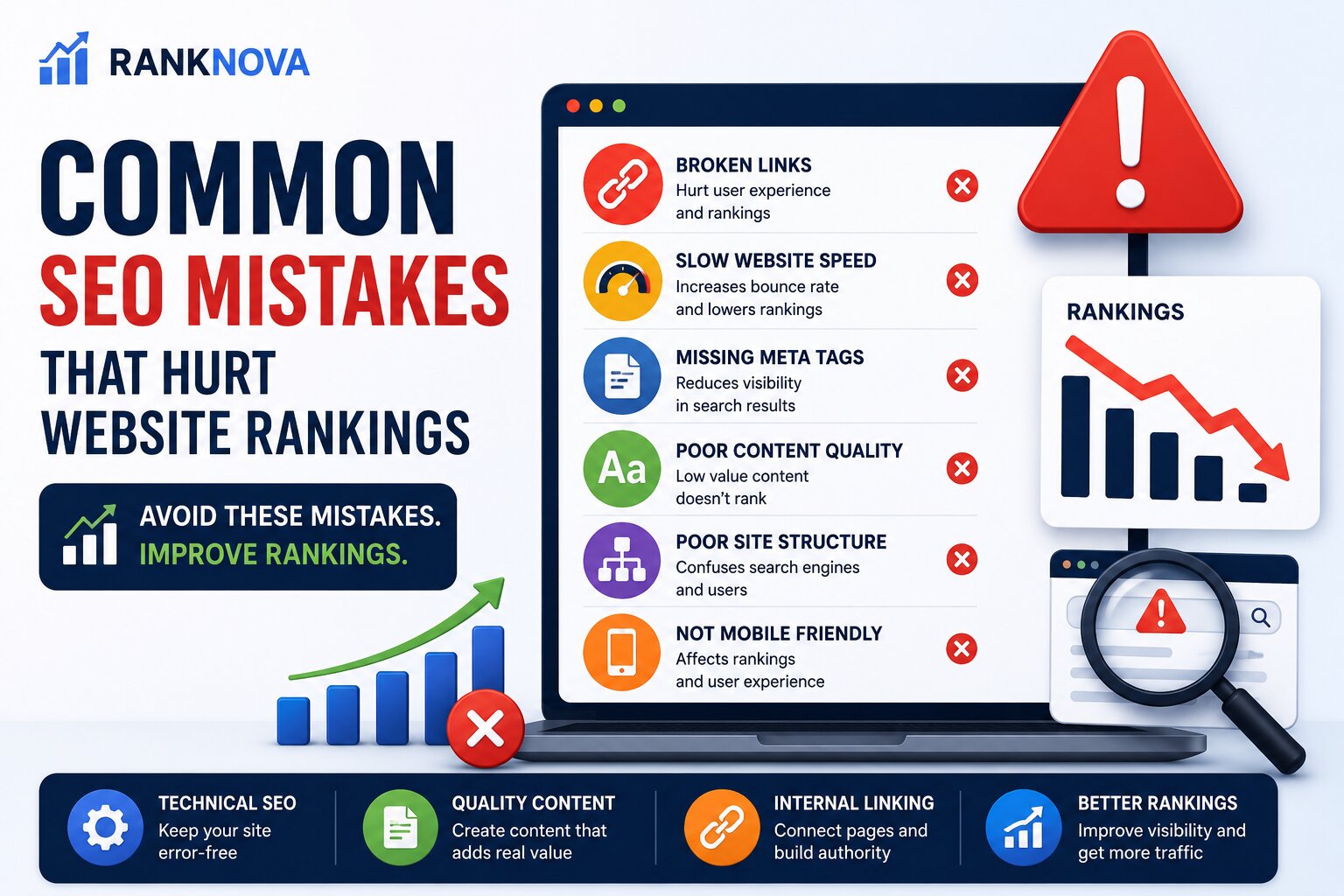
Common SEO Mistakes That Hurt Website Rankings
Many websites struggle to rank not because of competition — but because of avoidable SEO mistakes.
Even small technical or content-related issues can reduce visibility, traffic, and indexing performance.
In this guide, you’ll learn the most common SEO mistakes and how to fix them.
Why SEO Mistakes Matter
SEO mistakes can affect:
- crawling
- indexing
- rankings
- user experience
- AI visibility
Fixing SEO issues improves website performance over time.
1. Ignoring Technical SEO
Many websites focus only on content while ignoring technical SEO.
Issues like:
- slow loading speed
- crawl errors
- broken links
- mobile usability problems
can reduce rankings significantly.
Read our Technical SEO Checklist.
2. Poor Keyword Targeting
Targeting broad keywords only is difficult.
Instead:
- focus on long-tail keywords
- understand search intent
- target specific problems
Read our Long-Tail Keywords SEO Guide.
3. Weak Content Structure
Poorly structured content is difficult for users and AI systems to understand.
Common issues:
- long paragraphs
- missing headings
- weak readability
- no FAQs
Structured content performs better.
Read our How to Structure a Blog Post for SEO.
4. Missing Internal Links
Internal linking helps:
- improve crawling
- distribute authority
- increase engagement
Many websites publish blogs without connecting related pages.
Read our Internal Linking Strategy for SEO.
5. Keyword Stuffing
Overusing keywords reduces content quality.
Modern SEO focuses more on:
- clarity
- relevance
- helpfulness
- context
AI systems also detect unnatural content patterns.
6. Ignoring AI Search Optimization (GEO)
Search behavior is evolving.
Users now search through AI systems like ChatGPT.
Websites that ignore:
- FAQs
- structured content
- direct answers
- contextual information
may lose AI visibility.
Read our How to Optimize Content for ChatGPT and AI Search.
7. Weak Meta Titles & Descriptions
Meta tags affect click-through rate.
Bad titles reduce clicks even if impressions increase.
Good meta titles should:
- include keywords
- explain value
- encourage clicks
8. Publishing Inconsistently
SEO requires consistency.
Publishing one blog occasionally is not enough.
Consistent publishing helps build:
- authority
- topical relevance
- indexing frequency
9. Ignoring Mobile Optimization
Most users browse on mobile devices.
Poor mobile experience affects:
- engagement
- rankings
- conversions
Responsive websites perform better.
10. Not Monitoring SEO Performance
Without monitoring, SEO improvements become difficult.
Track:
- impressions
- clicks
- rankings
- crawl issues
- indexing
Use our Daily Keyword Rank Tracking Tool.
How Ranknova Helps
Ranknova helps identify:
- technical SEO issues
- content optimization gaps
- missing internal links
- crawlability problems
- AI visibility opportunities
It helps improve both SEO and GEO performance.
Conclusion
Most SEO problems are fixable.
Avoiding common SEO mistakes helps improve rankings, visibility, and user experience over time.
Focus on technical health, content quality, internal linking, and consistent optimization.
Related Guides
- Technical SEO Checklist
- How to Structure a Blog Post for SEO
- Internal Linking Strategy for SEO
- Long-Tail Keywords SEO Guide
- How to Optimize Content for ChatGPT and AI Search
CTA
👉 Use Ranknova to identify SEO mistakes affecting your website rankings and AI visibility.
FAQ
Frequently Asked Questions
Quick answers pulled directly from this article for easier reading and better sharing previews.
What is the biggest SEO mistake?
Ignoring technical SEO and content structure are among the most common SEO mistakes.
Can internal linking improve rankings?
Yes, internal linking improves crawling, authority distribution, and user engagement.
Why is AI SEO important?
AI search systems are becoming an important source of website discovery and visibility.
Can Ranknova detect SEO issues?
Yes, Ranknova helps identify technical, content, and AI SEO optimization opportunities.